
Complete Tadelakt Guide
This guide presents everything you need to know about Moroccan Tadelakt: its history, composition, application techniques and advice on choosing the right Tadelakt for your project.

Original Tadelakt
Tadelakt is a lime-based coating, shiny and waterproof, suitable for both interior and exterior use. It is the traditional coating of Moroccan hammams and palaces. Its complete waterproofing comes from natural lime and the gentle work of a river pebble — the Galet — combined with a black soap treatment.
Unlike other decorative plasters, Tadelakt is not merely aesthetic: it is a 100% natural and ecological material, free from synthetic resins, that naturally regulates humidity and does not promote the growth of mould or bacteria.
Technical Characteristics of Tadelakt
Before any application, it is essential to respect the technical conditions that ensure the durability and quality of the final result.
🧱 Surface Preparation
The ideal substrate is a non-smoothed, highly porous and adhesive plaster. Tadelakt can be applied on hydraulic lime plaster, ordinary mortar and cement. On plasterboard or gypsum, a coat of tile adhesive diluted 10% in water is required beforehand.
🌡️ Environmental Conditions
Minimum working temperature is +15°C. Avoid draughts and direct sunlight during application. Once Tadelakt application begins on a wall, it must be completed in a single working session to avoid visible joins.
⏱️ Working Times
Surfaces must be protected from moisture for approximately one month before the final waxing. The first coat is applied and allowed to partially dry before the second. Polishing with the river pebble and black soap treatment complete the application.
🎨 Colour Range
Tadelakt is available in a complete range of colours obtained with natural mineral pigments. A chromatic variation of 10–20% between the sample and the final result is normal, due to the artisanal nature of the product. Each work is unique and unrepeatable.
🧹 Maintenance
Regular cleaning is performed exclusively with water and diluted black soap. The use of acidic, descaling or aggressive cleaning products is strictly prohibited. Annual waxing with natural beeswax is recommended to preserve the shine.
🏠 Where to Apply
Tadelakt is suitable for: floors, walls, showers, bathtubs, swimming pools, sinks and furniture elements. Thanks to its natural waterproofing it is ideal for all damp environments. It can also be applied externally on vertical surfaces protected from direct rain.
The Tadelakt Application Process
Every Tadelakt project is a unique artisanal creation. Our master craftsmen from Marrakech follow a rigorous multi-step process to guarantee a flawless and lasting finish.
Surface Preparation
Inspection and preparation of the substrate: cleaning, removal of loose parts, application of bonding agent if necessary. The substrate must be porous, solid and free from rising damp.
First Application
Application of the first Tadelakt coat with a trowel. Thickness ranges from 3 to 5 mm. The coat is levelled and left to partially dry to the right consistency for working.
Second Application
Application of the second thinner coat (2–3 mm) on the still slightly damp first coat. This double application, unique to our method, guarantees greater compactness and surface uniformity.
Polishing with River Pebble
When Tadelakt reaches the right consistency, polishing begins with the Galet — the river pebble. The stone is worked in concentric circles compressing the lime and closing the pores of the surface, making it compact and waterproof.
Black Soap Treatment
Artisanal black soap (Beldi) is applied to the still fresh surface. The chemical reaction between the lime and the fatty acids of the soap creates an insoluble soap that permanently waterproofs the Tadelakt, giving it shine and protection.
Final Waxing
After approximately one month of drying and carbonation, natural beeswax is applied to protect the surface and intensify its shine. Annual waxing keeps Tadelakt in perfect condition over time.
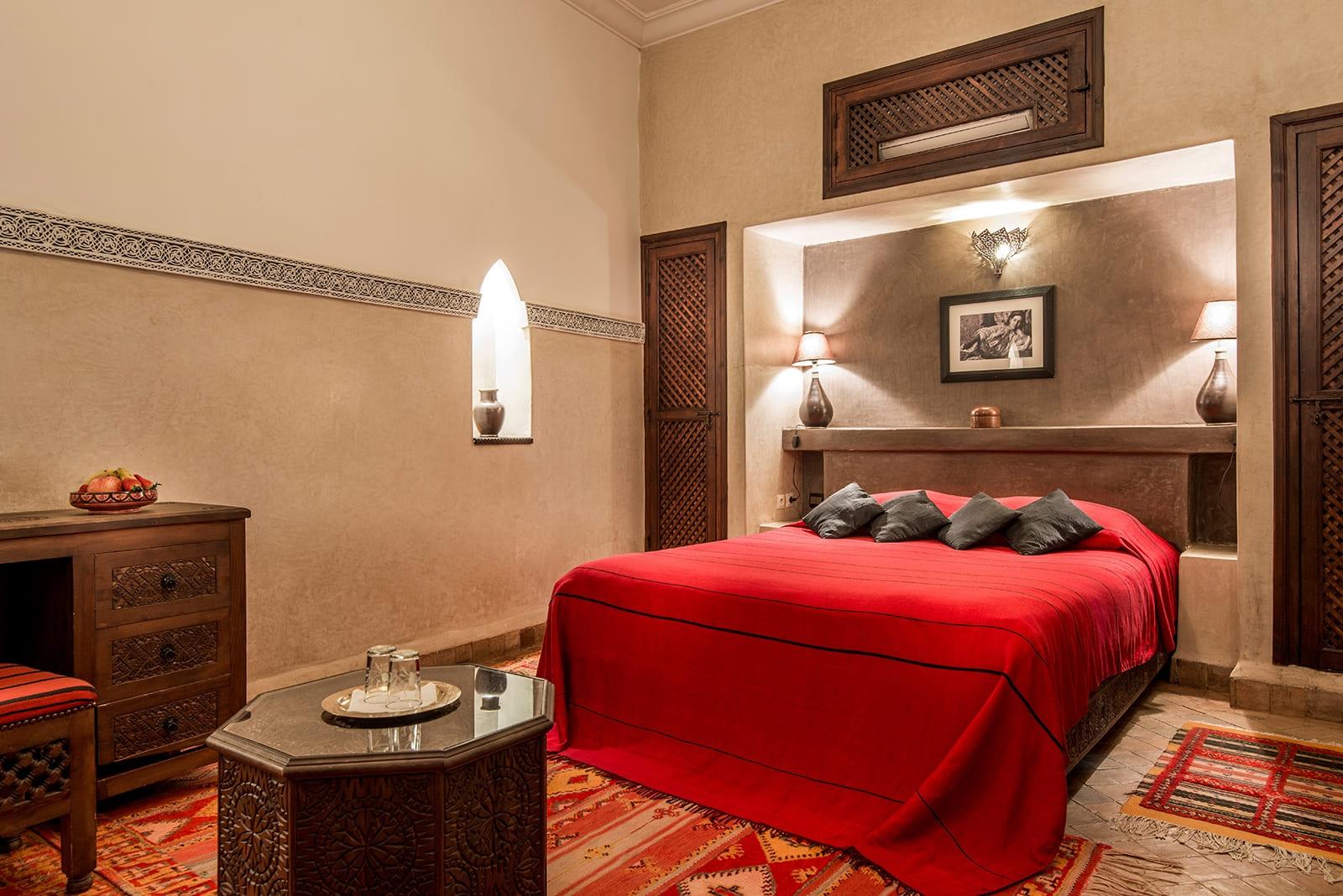
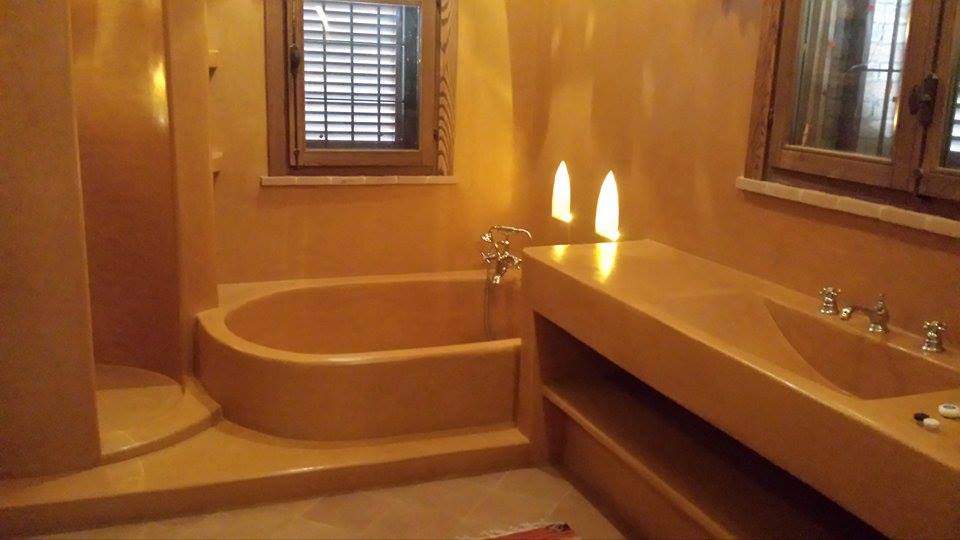
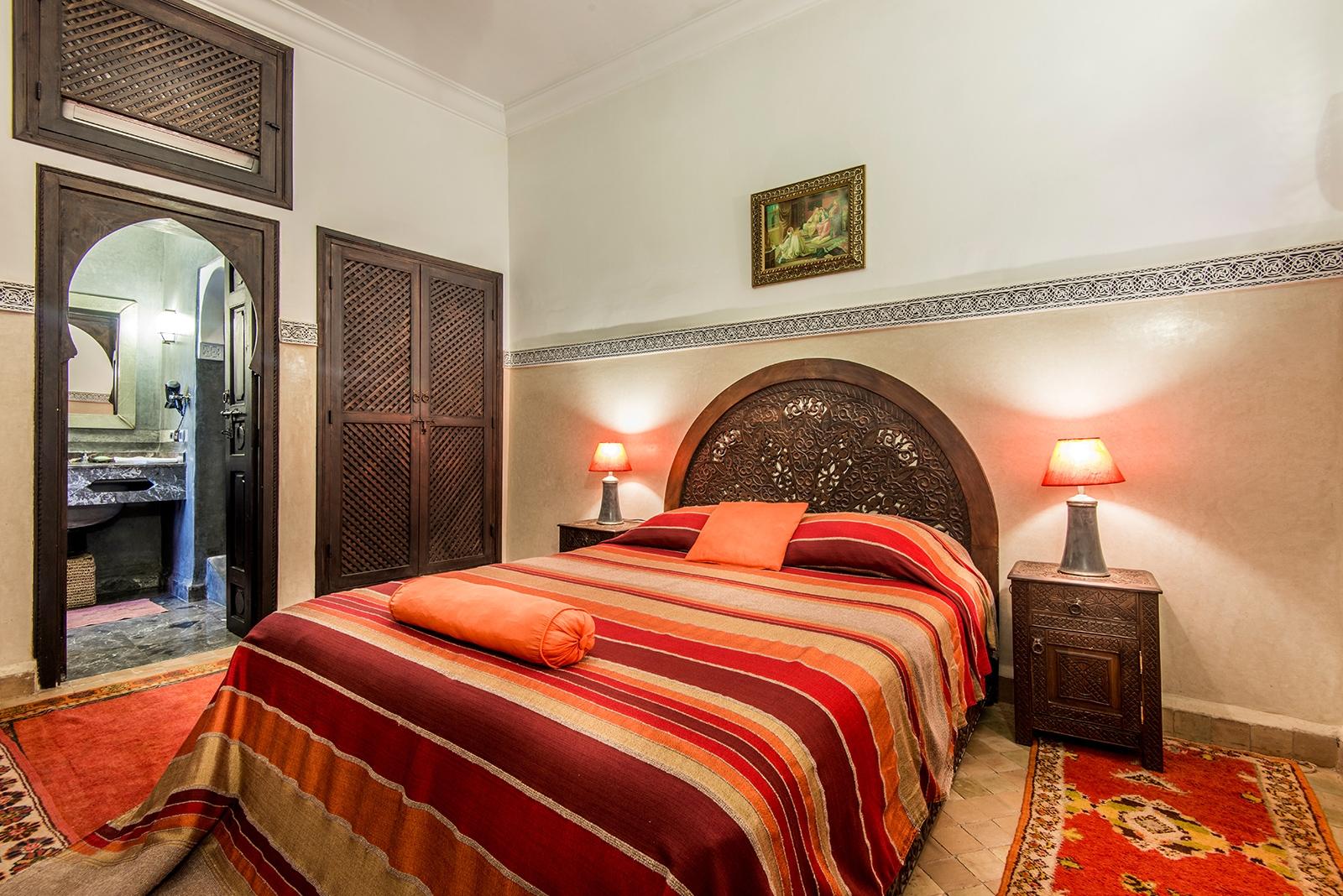
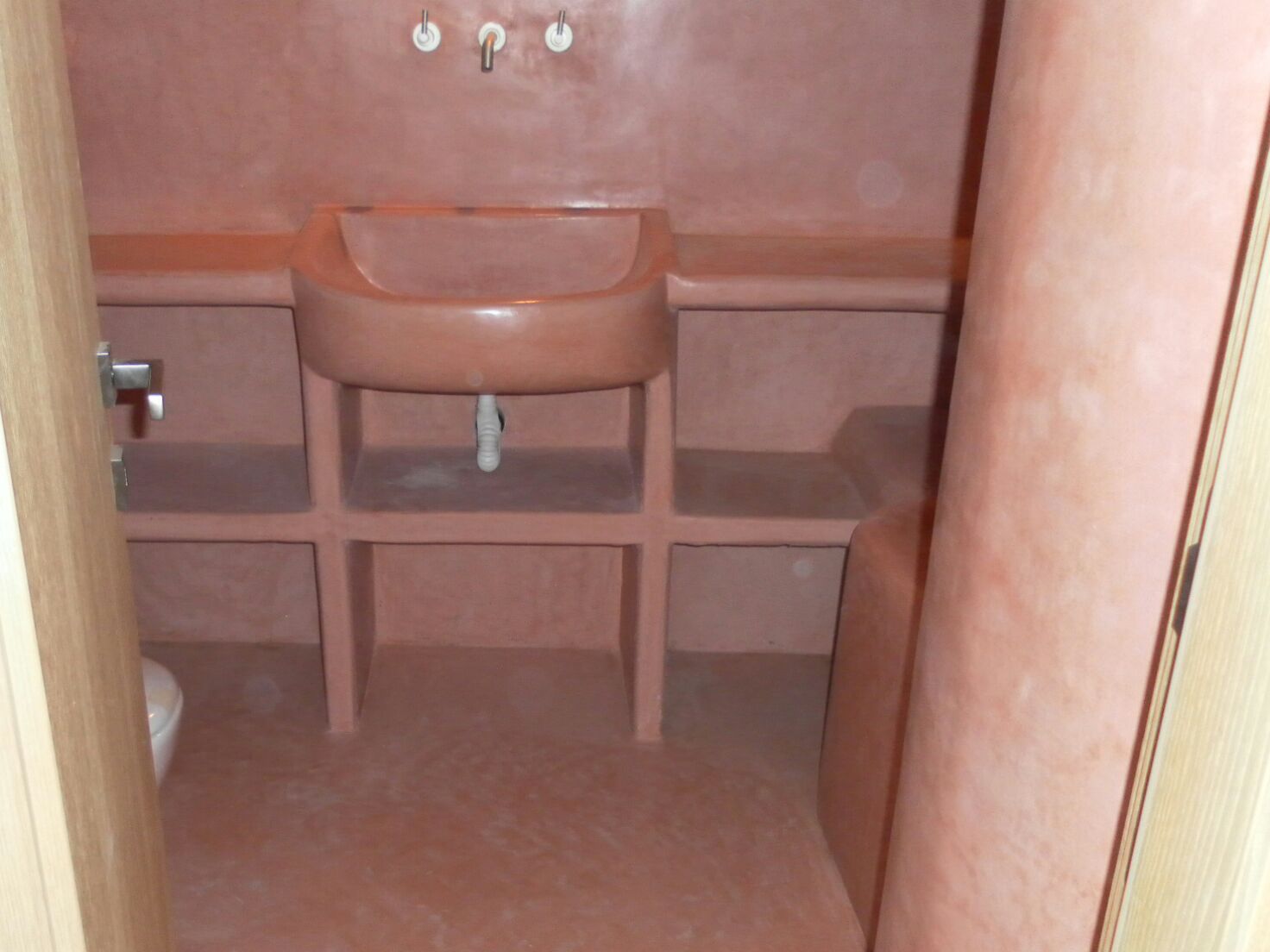
Some Realisations
Questions about Original Tadelakt
Answers to our clients' most frequently asked questions
Tadelakt is a lime plaster, shiny and waterproof, with an appearance similar to polished stone. Originating from Marrakech, it has been used for centuries in the hammams and riads of the medina. It is distinguished by its polishing technique using river pebbles and treatment with black olive soap.
Air lime is extracted from pure limestone and sets upon contact with air through carbonation. It is very white and ideal for decorative finishes but is not waterproof.
Natural hydraulic lime (NHL), used in Tadelakt, contains 5% to 20% clay and sets both in contact with air and water. The hardening process combines approximately 30% carbonation and 70% crystallisation — hence its exceptional water resistance.
In appearance the two coatings may seem similar, but they have substantial differences. Italian Venetian stucco is primarily decorative and not waterproof: it requires the application of protective resins or waxes to resist moisture.
Moroccan Tadelakt, however, is intrinsically waterproof thanks to its composition and application process. It is also an ecological and healthy material that releases no chemicals, naturally regulates humidity and does not promote mould or bacteria growth.
Traditional Tadelakt is made with natural hydraulic lime from Marrakech, extracted from local quarries and rich in natural minerals including quartz sand, marble powder, clays, ash, diatomite and cellulose.
Natural mineral pigments are added to achieve the desired colour. The formula has remained substantially unchanged for centuries, passed down through generations of Berber craftsmen. No synthetic additives, no resins: only natural raw materials.
Tadelakt is as fragile as most lime-based plasters, but correct application and good finishing considerably improve its durability. Well-applied and regularly maintained surfaces last for decades.
In case of small localised damage, Tadelakt can be repaired locally without redoing the entire surface — an important advantage over ceramic tiles.
Yes, Tadelakt is hermetically sealed against water. This plaster is scraped and polished multiple times with the river pebble, then treated with artisanal black soap. The chemical reaction between the lime and the fatty acids of the soap creates an insoluble soap that permanently waterproofs the surface.
The carbonation process continues in the months following application, making Tadelakt increasingly compact and resistant over time.
Applied Tadelakt plaster measures between 3 and 8 millimetres in total thickness, generally distributed over two successive coats.
The first coat (3–5 mm) forms the structural base and is left to partially dry. The second coat (2–3 mm), thinner and finer, is the one worked with the river pebble to achieve the shine and waterproofing characteristic of Tadelakt.
In Marrakech, Berber craftsmen work with simple but effective tools: the trowel for spreading and the Galet — the river pebble — for polishing. The traditional technique uses a single application; we use a double-layer method for superior quality.
The process consists of 6 phases: substrate preparation → first coat → second coat on fresh → pebble polishing → black soap treatment → final waxing after one month.
The ideal substrate is a dry hydraulic lime plaster, non-smoothed, porous and adhesive. Tadelakt can also be applied on ordinary mortar and cement, provided the substrate is solid and free from rising damp.
On plaster and plasterboard, a coat of tile adhesive diluted 10% in water is mandatory before application. It cannot be applied directly on painted surfaces, tiles or any non-porous substrate without prior treatment.
Maintaining Tadelakt is surprisingly simple. Regular cleaning is done with a soft sponge and black soap diluted in water. Gently wipe the surface, rinse and dry.
It is forbidden to use acidic, descaling, bleach or aggressive cleaning products. Annual waxing with natural beeswax is recommended to maintain the original shine and renew surface protection.
Tadelakt, if correctly applied and properly maintained, lasts for decades. In the traditional hammams of Marrakech, Tadelakt walls applied over a century ago can still be found in perfect condition.
Longevity depends primarily on the quality of application, respect for technical conditions and correct maintenance. Unlike tiles or synthetic panels, Tadelakt improves with time: lime carbonation continues for years, making the surface increasingly compact and resistant.
Have a Project in Mind?
Our Marrakech craftsmen are at your disposal for a free quote and personalised consultation. Contact us to discuss your original Tadelakt project.